
An organizational structure is a system that specifies how particular operations are to be carried out in order to accomplish the organization’s objectives. These activities may include enforcing norms, assigning roles, and delegating responsibilities. An organizational structure establishes the direction of activities such as task distribution, coordination, and supervision in order to accomplish organizational goals. The organizational structure has an effect on how the organization operates and serves as the framework for standard operating procedures and routines. It establishes which persons have access to certain decision-making processes and consequently the extent to which their perspectives influence the organization’s activities.
Additionally, the organizational structure dictates how information moves between levels inside the business. For instance, in a centralized structure, decisions are made at the top, whereas in a decentralized structure, decision-making authority is divided among several organizational levels.
When it comes to businesses, an organizational structure is a visual diagram that depicts what people do, who they report to, and how decisions are made across the firm as a whole. Organizational structures can be guided by functions, markets, products, geographies, or processes, and they can be tailored to meet the needs of enterprises of varying sizes and industries, among others.
An organizational chart is a diagram that visually depicts a business’s internal structure by outlining the roles, responsibilities, and interactions between the many personnel within the organization. Organizational charts are visual representations of a person’s position in the company’s hierarchy in relation to other employees within the organization. Organization charts, regardless of the structure of a company, are extremely beneficial when a company is considering reorganizing its staff or changing its management style. Most importantly, organizational charts allow employees to see how their individual roles fit into the larger structure of the company.
According to Harold Koontz and Cyril O’ Donnell, “Every organization can be charted, for a chart is nothing more than an indication of how departments are tied together along their principal lines of authority.”
In the words of George R Terry, “A chart is a diagrammatical form which shows important aspects of an organization including the major functions and their respective relationships, the channels of supervision, and the relative authority of each employee who is in charge of each respective function.”
According to Louis A Allen, “The organization chart is a graphic means of showing organization data. Organization charts are snap-shots; they show only the formal organization and depict it for only a given moment in time.”
In the word of J Batty, “An organization chart is a diagrammatic representation of the framework or structure of an organization.”
According to Henry H Albens, “An organization chart portrays managerial positions and relationships in a company or department unit.”
Types of organization structures
1. Hierarchical organizational structure
Hierarchical organizations are those in which every entity in the organization, except for one, is subordinated to another entity at the top of the organization’s organizational hierarchy. This layout can be thought of as a type of hierarchy. An organization’s hierarchical structure is often comprised of a single/group of powerful individuals at the top, with successive levels of power beneath them. Most big organizations, such as corporations, governments, criminal enterprises, and organized religions, are hierarchical in nature, with varying levels of management, power, and authority at different levels of the organization.
 Advantages of hierarchical organization structure
- Improved definitions of levels of authority and accountability
- Shows who each individual reports to and who should be contacted about certain tasks.
- Employees are motivated by clear career routes and opportunities for advancement.
- Each employee is assigned a specialization.
- Enables personnel in the same department to get more friendly with one another
Disadvantages of hierarchical organization structure
- Increased bureaucracy has the potential to slow innovation and significant transformation.
- Employees may be influenced to act in the best interests of their department rather than the organization as a whole.
- Lower-level employees may feel that they have less ownership and that they are unable to voice their thoughts for the organization as a whole.
- It takes a lot of time in making and implementing viable decisions
- It creates a communication barrier
2. Horizontal organizational structure
A horizontal or flat organizational structure is appropriate for businesses with few layers of management between higher management and staff-level employees. Many start-up businesses operate under a horizontal organizational structure until they grow large enough to establish separate departments, but some organizations continue to operate under this structure because it encourages less supervision and more involvement on the part of all employees.
When an organization is organized in a horizontal or “flat” manner, there are only a few layers of management in the organization. In a flat organizational structure, managers have a broad span of control over a larger number of subordinates, and the chain of command is typically short. When using this structure, the communication pathway is short, which results in communication that is both faster and more effective in many cases. Smaller businesses and organizations that take a more modern approach to management are more likely to have a flat organizational structure than larger organizations.
Advantages
- Employees are given more responsibilities.
- Increases the likelihood of more open communication
- Enhances the coordination and speed with which new ideas are implemented.
- It promotes delegation of authority, hence alleviating the top manager’s workload.
- It avoids duplication of effort, hence increasing efficiency.
Disadvantages
- Employees may be confused because they do not have a clear supervisor.
- Can be difficult to maintain once the company grows.
- There is a constant emphasis on specialization.
- It maximizes the cost of supervision.
- It is impervious to environmental change.
- It discourages innovation and creativity.
3. Functional organization structure
A functional organizational structure is similar to a hierarchical organizational structure in that it starts with positions with the highest levels of responsibility at the top and works its way down from there. Rather than this, personnel is grouped primarily according to their individual skills and their associated role inside the organization. It is the responsibility of each department to handle itself independently.
A functional organizational structure is a type of organizational structure that is used to arrange employees. They are organized into groups based on the specific talents and information they possess. It organizes each department vertically, with positions ranging from the president to the finance and sales departments, through customer support, to employees who are assigned to a particular product or service. Functional organizations are made up of specialized units that are all accountable to a single authority, which is typically referred to as top management.

Advantages
- Employees are able to concentrate on their jobs.
- Specialization is encouraged.
- Assist teams and departments in feeling self-sufficient.
- Employees may become bored if their regular tasks are the same.
- Due to the fact that employees are classified according to their knowledge and abilities, competition amongst them may occur.
Disadvantages
- Employees may become tired of repetitive tasks.
- Because employees are grouped by knowledge and skills, competition may occur.
- Departmental and unit coordination may be lacking. Lack of teamwork and adaptability can lead to departmental and unit problems.
- With a larger organization, it may be difficult to oversee and regulate the work.
- Departments may focus on their own aims rather than the organizations.
- Decisions may be delayed due to strong hierarchy and bureaucracy.
- Employees that are experts in their subjects and departments will cost more. High-skilled employees are costly.
- A functional organizational structure’s rigidity makes change adaptation harder.
4. Divisional organizational structure
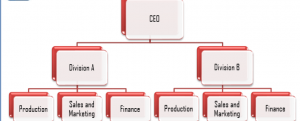
Divisional organizational structures are those in which a company’s divisions have autonomy over their own resources, allowing them to function almost as if they were separate companies within the larger organization. Each division may have its own marketing team, sales team, information technology team, and so on. This structure works well for large corporations because it empowers the many divisions to make choices without requiring everyone to report to a small number of executive-level managers or directors.
A divisional structure can be found in any organization that divides its employees and other resources into different groups based on regional and product differences, with each group being responsible and answerable for its own actions. Divisional structures can be found in any organization that has a divisional structure.
Advantages
- Each division can function independently.
- Each division receives an acceptable amount of autonomy.
- Division managers develop as subject matter experts in their respective fields
- This is an excellent training ground for strategic management.
- This structure may provide opportunities for career advancement.
- Decisions can be made efficiently and effectively.
Disadvantages
- This structure is incompatible with small businesses.
- Headquarters struggles to maintain control over each section.
- Duplication of activities is possible across divisions.
- Can be quite costly; when each section engages in its own autonomous service, costs may rise.
- When each divisional manager protects only his or her own interests, the organization’s shared aim is overlooked.
- The divisional heads clash with another divisional head.
- Can focus primarily on short-term results.
- As a result, a company may find itself competing with itself.
5. Matrix organizational structure
A matrix organizational chart resembles a grid and depicts cross-functional teams formed for special projects. For example, an engineer may belong to the engineering department (which is led by an engineering director) on a regular basis but work on a temporary project (led by a project manager). Both of these roles and reporting relationships are accounted for in the matrix org chart.
A matrix organization is one that has multiple lines of reporting management. In practice, this means that the organization’s employees have more than one supervisor!
Although the matrix organizational structure is complex, it aids in the achievement of the final goal, which is increased productivity. It breaks up the routine and provides the organization with greater flexibility. Employees collaborate with colleagues from several departments who specialize in various functions.
When individuals from different departments collaborate, it enables more efficient problem-solving. It does result in the overall growth of personnel, as each is exposed to functions other than their primary employment.
 Advantages
- Allows supervisors to easily select individuals based on project requirements.
- Provides a more dynamic picture of the organization
- Encourages employees to use their skills in roles other than their original ones.
- Increased teamwork
- Maximizes resource usage
Disadvantages
- It depicts a conflict between department heads and project managers.
- Changes more frequently than other types of organizational charts
- Potential conflict between managers and projects
- Authority confusion
- Reduced employee effectiveness